

Architecture
Co-location on a chip
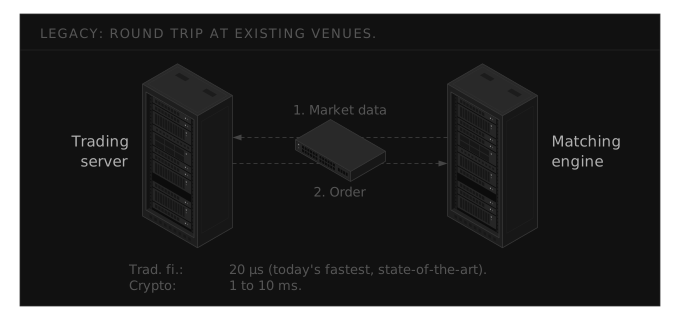
Section titled “Co-location on a chip”At a typical venue, market data is published from the matching engine and consumed on separate trading servers. Trading algorithms respond by sending orders back across the network.
Systematic traders often find that their strategies compete with others for the same opportunities. In response to this, they first co-locate their servers in the same datacenter as the matching engine to reduce network latency in both directions. Once co-located, they turn to optimizing tick-to-trade latency: their own system’s time from receiving market data to the resulting send.
Round-trip latency is the total time from an exogenous event arriving at the matching engine to the trader’s response arriving back at the matching engine: matching, market data publication, the network path to the trader, the trader’s tick-to-trade, the network path back, and order entry at the venue. A round trip at the fastest traditional markets takes approximately 20 µs [1]; at major crypto markets, on the order of milliseconds.
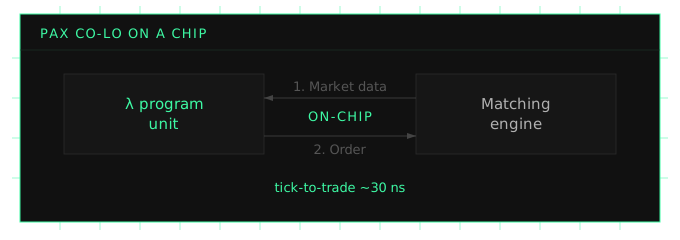
PAX optimizes round-trip latency, that is, the whole circuit rather than one segment of it. In so doing, PAX simultaneously reduces matching latency and the latency to and from the matching engine. The PAX λ API hosts participant decision logic on the same chip as the matching engine. Market data is available to λ programs within nanoseconds of publication, without network transit between separate machines. A round trip at PAX takes approximately 40 ns.
Round-trip latency also measures how fast the entire market state can evolve. Compared to the fastest state-of-the-art matching systems that require 20 µs, PAX is 500x faster at 40 ns [2]. Thus, at PAX systematic traders can disseminate information within and across markets at a rate unparalleled at any venue. But most importantly, any given systematic strategy gains an advantage on its own fill rate by proximity to the matching engine which is what a λ program offers.
Note 1. Insights into Trading System Dynamics: Deutsche Börse’s T7.
Note 2. A microsecond (µs) is one millionth of a second; a nanosecond (ns) is one billionth, so 20 µs is 20,000 ns, and 20,000 ns ÷ 40 ns = 500x.
Regulated services provided by 1Money USA, Inc., a licensed money transmitter, NMLS ID 2628653 · Licenses